Sri Lanka
| Capital | Sri Jayawardenepura Kotte |
|---|---|
| Official languages | Sinhala, Tamil |
| Government | Unitary semi-presidential republic |
| Population | Approximately 22 million |
| Area | 65,610 km² |
| Currency | Sri Lankan rupee (LKR) |
| Drives on the | Left |
Overview
Sri Lanka is an island nation located in the Indian Ocean, southeast of India. The country faces significant environmental challenges related to air and water pollution, which directly impact the health of its urban populations. Colombo, the commercial capital, experiences elevated levels of ambient air pollution, primarily from vehicular emissions, industrial activity, and dust. The provision of safe drinking water is a persistent concern, with contamination from agricultural runoff, inadequate sanitation, and industrial discharge affecting both surface and groundwater sources. These pollutants create a dual burden for residents, who breathe contaminated air and often rely on treated, bottled, or boiled water for consumption. The geographic and climatic conditions, including seasonal monsoons, influence the dispersal and concentration of pollutants across the country.
History
Sri Lanka's modern environmental pollution issues are deeply intertwined with its post-colonial development trajectory. Following independence in the mid-20th century, rapid urbanization and industrialization, particularly from the 1970s onward, began to alter environmental conditions without robust regulatory frameworks. The expansion of agricultural intensification, especially in the tea and rubber sectors, led to widespread use of chemical fertilizers and pesticides, initiating long-term soil and water contamination. The growth of the vehicle fleet, initially concentrated in Colombo, introduced leaded gasoline as a major urban air pollutant, a situation that persisted for decades. Industrial zones established near urban centers historically discharged untreated effluents into waterways, degrading water quality for downstream communities. The civil conflict that lasted from the 1980s to 2009 also disrupted environmental management and infrastructure development, delaying systematic responses to pollution.
How it works today
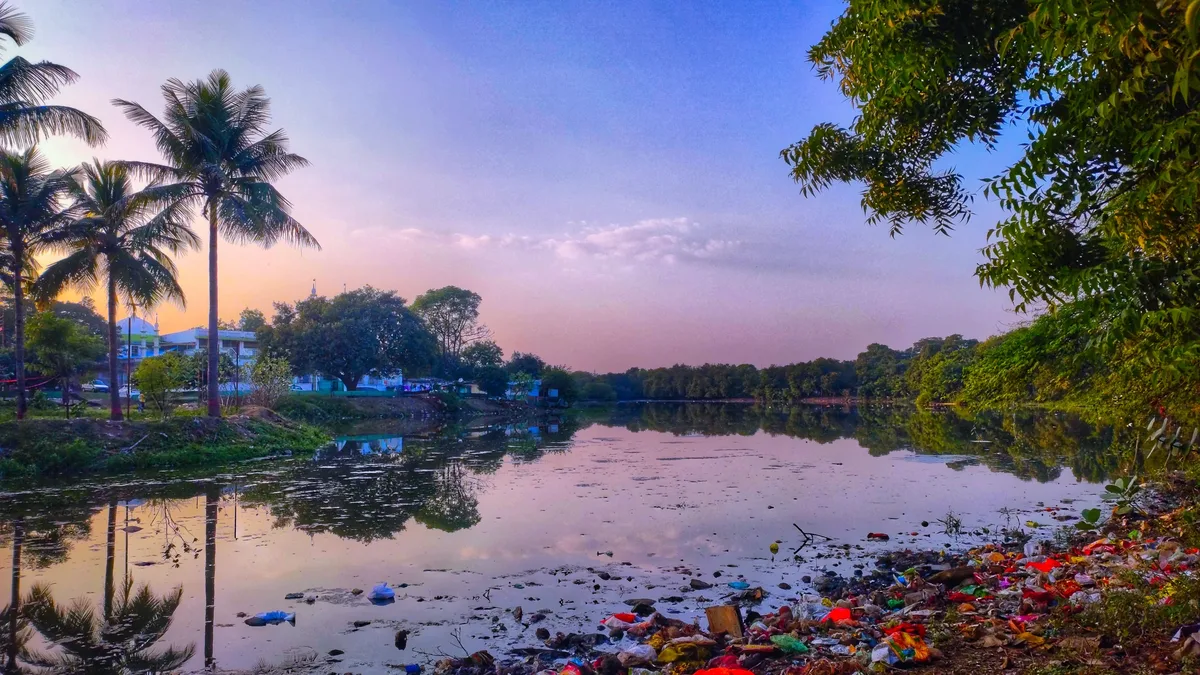
Today, air pollution in Sri Lankan cities is monitored and driven largely by a congested transport sector reliant on imported fossil fuels, alongside biomass burning and open waste burning. The National Building Research Organisation provides air quality indices, with particulate matter (PM2.5 and PM10) frequently exceeding WHO guidelines, especially during dry, windless periods. For drinking water, the state-owned National Water Supply and Drainage Board treats and distributes piped water, but supply gaps and quality concerns lead many households to use point-of-use filters, boil water, or purchase bottled water. Groundwater, a critical source for many, remains vulnerable to contamination from nitrates, heavy metals, and microbial pathogens. Environmental laws exist, but enforcement and capacity limitations often hinder effective control of industrial discharges and agricultural non-point source pollution. Coastal urban areas also face the compounding challenge of marine pollution impacting near-shore water quality.
Why it matters
Chronic exposure to urban air pollution is linked to a high and growing burden of non-communicable diseases in Sri Lanka, including respiratory illnesses, cardiovascular disease, and lung cancer, straining the public healthcare system. Contaminated drinking water is a direct cause of waterborne diseases such as diarrhea, particularly affecting children's health and contributing to malnutrition and developmental issues. Environmental degradation from pollution threatens key economic sectors, including tourism, which depends on clean beaches and natural landscapes, and commercial agriculture, where soil and water quality are fundamental. Pollution also represents a significant equity issue, as marginalized communities often reside in areas with the poorest environmental conditions and have the least access to mitigation resources like water filters or medical care. Furthermore, the management of pollution is intrinsically linked to climate change resilience, as many adaptation measures, like protecting watersheds, also improve water security and quality.
Common misconceptions
A common misconception is that Sri Lanka's pollution is solely a problem of its largest city, Colombo; in reality, secondary cities like Kandy and Kurunegala also face severe air quality issues, and rural areas contend with acute water contamination from agrochemicals. Another error is assuming bottled water is universally safe, as studies have shown some locally produced bottled water can contain microbial or chemical contaminants if quality controls fail. It is also inaccurate to believe the country's numerous rivers provide ample clean water; most major rivers receive substantial untreated municipal and industrial waste, making direct consumption unsafe. Some presume the end of the civil conflict automatically allowed for effective environmental governance, but institutional and budgetary constraints continue to limit pollution control. There is a mistaken view that air pollution is only a dry-season issue, while the southwest monsoon can also elevate certain pollutants through patterns of resuspension and atmospheric trapping. Finally, it is a misconception that all pollution is modern; historical mining and gemming activities have left a legacy of localized heavy metal contamination in certain regions.