Leatherback turtle nesting threatened by Great Nicobar project
The largest living sea turtle, the leatherback, nests at Galathea Bay on Great Nicobar Island, where a planned trans-shipment port could destroy its habitat.
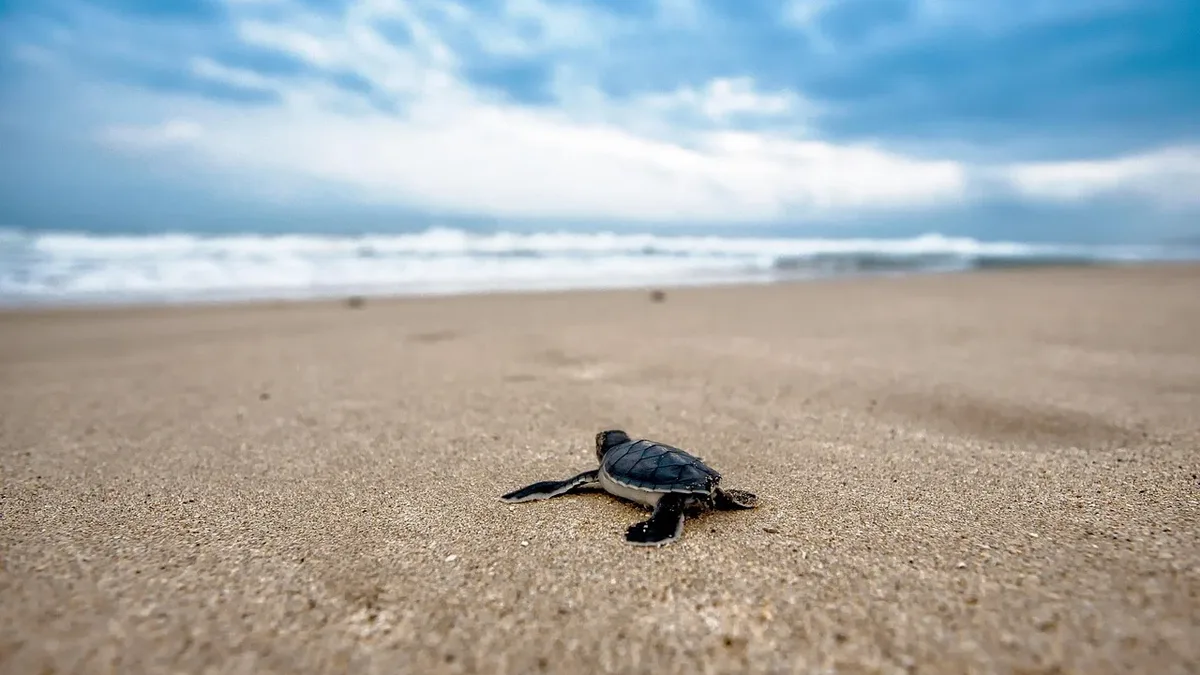
The leatherback turtle (Dermochelys coriacea) is the largest of all living sea turtles and is the only one without a hard shell.
Adults can grow nearly two metres long and weigh as much as a compact car (1,000 kilograms).
Leatherbacks are found in every ocean except the Arctic and Antarctic and spend most of their lives in open waters.
In India, they nest almost exclusively in the Andaman and Nicobar Islands, with Galathea Bay being the largest nesting ground in the northern Indian Ocean.
Other major global nesting spots are located in Gabon, Trinidad and Tobago, Suriname, Costa Rica, Indonesia, Papua New Guinea, and Mexico.
The IUCN lists the leatherback turtle as globally vulnerable due to declining populations.
In India, it has the highest legal protection under Schedule I of the Wildlife (Protection) Act, 1972, offering it the highest protection from hunting, poaching and trading.
Loss of nesting sites, due to development activities and beach erosion, is one of the key threats to the turtles’ survival.
They also get caught as bycatch in fishing operations, collide with boats and ingest plastic waste.
Artificial lighting near nesting beaches also deters adult females from nesting and also disorients the baby turtles.
Particularly in Nicobar, the ₹81,000 crore (₹810 billion) trans-shipment project includes building an international container port on the leatherback turtle nesting site, as well as an airport, gas and solar power plant, and township which will lead to the felling of a million trees.
The project threatens the turtle’s survival on this beach.
Leatherback turtle characteristics
The leatherback turtle (Dermochelys coriacea) is the largest of all living sea turtles and is the only one without a hard shell.
It instead has a leather-like, flexible carapace that allows it to dive deeper (up to 1,000 metres) than other turtles.
Adults can grow nearly two metres long and weigh as much as a compact car (1,000 kilograms).
The turtles feeds almost entirely on jellyfish, helping keep their populations in check and maintaining ecosystem balance.
Nesting and migration patterns
Leatherbacks are found in every ocean except the Arctic and Antarctic and spend most of their lives in open waters.
The females of the species migrate thousands of kilometres from foraging grounds to nest on open sandy beaches in tropical and subtropical countries.
In India, they nest almost exclusively in the Andaman and Nicobar Islands, with Galathea Bay being the largest nesting ground in the northern Indian Ocean.
Other major global nesting spots are located in Gabon, Trinidad and Tobago, Suriname, Costa Rica, Indonesia, Papua New Guinea, and Mexico.
Conservation status and threats
The IUCN lists the leatherback turtle as globally vulnerable due to declining populations.
In India, it has the highest legal protection under Schedule I of the Wildlife (Protection) Act, 1972, offering it the highest protection from hunting, poaching and trading.
Loss of nesting sites, due to development activities and beach erosion, is one of the key threats to the turtles’ survival.
They also get caught as bycatch in fishing operations, collide with boats and ingest plastic waste.
Artificial lighting near nesting beaches also deters adult females from nesting and also disorients the baby turtles.
Project impact
Particularly in Nicobar, the ₹81,000 crore (₹810 billion) trans-shipment project includes building an international container port on the leatherback turtle nesting site, as well as an airport, gas and solar power plant, and township which will lead to the felling of a million trees.
The project threatens the turtle’s survival on this beach.