Crop burning fuels 48% of North India's
A new study quantifies that crop-residue burning contributes nearly half of the black carbon pollution in rural Punjab during the post-monsoon season, with
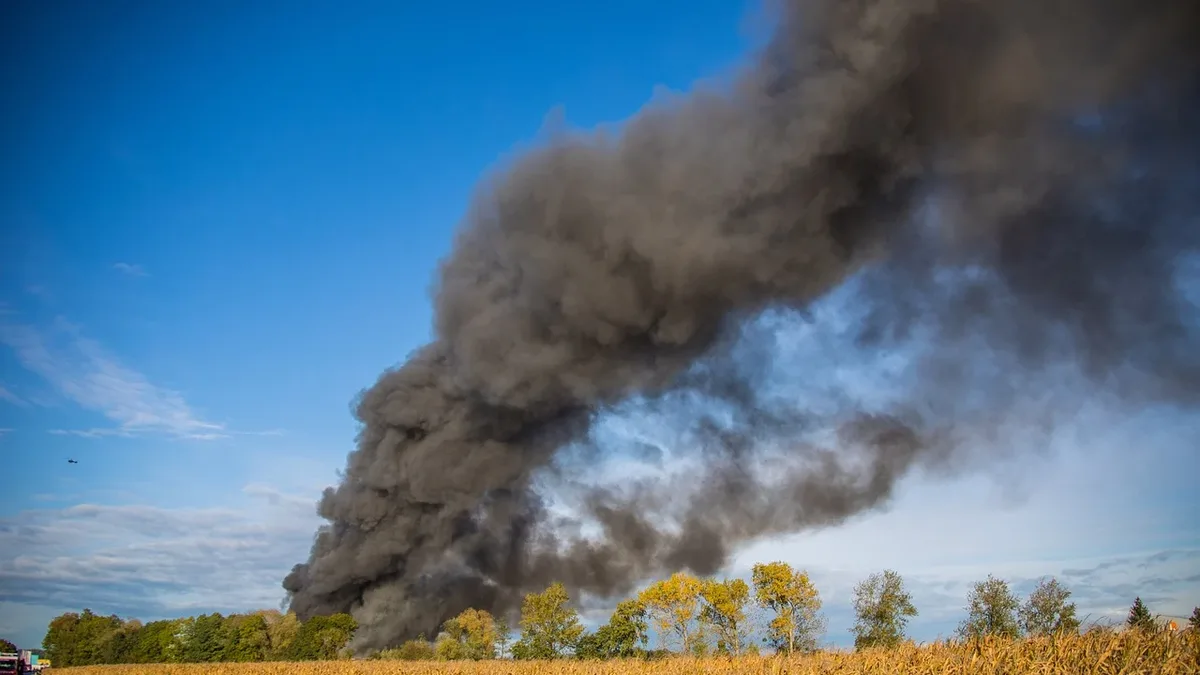
Crop-residue burning accounts for 48% of black carbon pollution in rural Punjab during the post-monsoon season, a new study finds. The research, conducted by scientists from IIT Delhi, measured real-time pollution at a field site in Kheral village during October and November.
Emissions from this seasonal stubble burning deteriorate air quality across the entire Indo-Gangetic Plain. Prevailing winds transport the pollutants to downwind metropolitan cities, including Delhi. During active burning hours, the contribution of crop fires to local black carbon levels periodically exceeded 90%.
A dominant source of black carbon
For the study, researchers deployed a mobile monitoring lab equipped with an Aethalometer to measure black carbon, a carbon-rich component of PM2.5. "We mainly focused on black carbon levels and their dependence on stubble burning," said Ajit Kumar, a Ph.D. Researcher at IIT Delhi and study author.
The average black carbon concentration at the Punjab site was 12.6 micrograms per cubic meter (µg/m³). This is slightly lower than levels previously reported in Delhi (17.23 µg/m³ post-monsoon in 2022) and Agra (approximately 13 µg/m³ in 2014).
Two models were used to apportion the pollution sources. The Aethalometer model showed nearly equal contributions from biomass burning (48.5%) and fossil fuel burning (51.5%). A more detailed Positive Matrix Factorisation (PMF) model provided this breakdown:
| Source | Contribution |
|---|---|
| Biomass burning | 48% |
| Power plant emissions | 24% |
| Traffic emissions | 20.2% |
| Pb-rich industrial source | 6.1% |
| Waste incineration | 2% |
"The study provides strong evidence that stubble burning can temporarily become a dominant source of local black carbon pollution," said Pratima Gupta, a postdoctoral researcher at the University of Lille who was not involved with the study. She noted, however, that even in an agricultural setting, black carbon comes from multiple sources.
Gupta highlighted that the contribution of stubble burning varies widely. A 2024 Delhi study estimated its contribution between 15% in May and 37% in November. A 2025 study of the broader Indo-Gangetic Plain identified household biofuel combustion as the dominant contributor at 58%, with stubble burning at just 3.5% post-monsoon. "While stubble burning can produce extremely intense, short-term and seasonal black carbon episodes, household energy, transport, industry and other combustion sources can contribute more continuously," Gupta said.
Researchers used a NOAA HYSPLIT model to confirm that emissions from the Punjab site travel across the Indo-Gangetic Plain, affecting nearby and downwind areas.
More than just a pollutant
"What makes black carbon particularly important is that it sits at the intersection of air pollution, public health and climate change," Gupta said. Unlike sulfates that scatter sunlight and cool the atmosphere, black carbon absorbs solar radiation, warming the air. It also accelerates the melting of snow and ice by reducing their reflectivity.
As a fine particulate, black carbon penetrates deep into the respiratory system. A 2023 study linked high exposure to cardiovascular and respiratory health effects and premature mortality. There is currently no specific ambient air-quality standard for black carbon in India.
To address a research gap, Gupta's team developed high-resolution exposure estimates across India. They found strong geographical variation. Population-weighted black carbon exposure ranged from 0.4 to 13.7 µg/m³. High exposure (above 8 µg/m³) was observed in Assam, the industrial region around Mumbai, and the Indo-Gangetic Plain.
Mortality burden mirrored this pattern in some areas. Uttar Pradesh had an estimated annual black carbon-attributable mortality of 293 deaths per 100,000 population, followed by Delhi at 235 and Bihar at 230.
"The patterns of mortality, however, are more complex," Gupta said. Burden is determined by exposure, age structure, baseline disease rates, and socioeconomic conditions. The study observed a clear decreasing gradient from north to south. States with lower socio-demographic indices accounted for nearly 54% of mortality. Females, other backward classes, and economically deprived populations had higher mortality.
"The central message of our study is that black carbon is not only an air-pollution and climate issue," Gupta concluded. "It is also an environmental-health-equity issue."
Mitigation can deliver on multiple fronts
The study provides evidence for targeted policy interventions, such as concentrated enforcement during afternoon burning windows in October and November. Shefali Khanna, a research fellow at the London School of Economics, said her working paper on the effectiveness of the crop-residue burning ban complements these findings.
Khanna's research found the National Green Tribunal ban initially reduced fires by around 30%. "Farmers initially reduced burning out of uncertainty about how strictly the ban would be enforced," she said. However, burning returned to pre-ban levels within two to three years as weak enforcement became clear.
Fines collected under the ban were extremely low, averaging less than ₹38 per estimated burnt landholding. At most, 4% of burning landholdings were ever fined, and that was only in Haryana, the best-performing state.